Accreditation
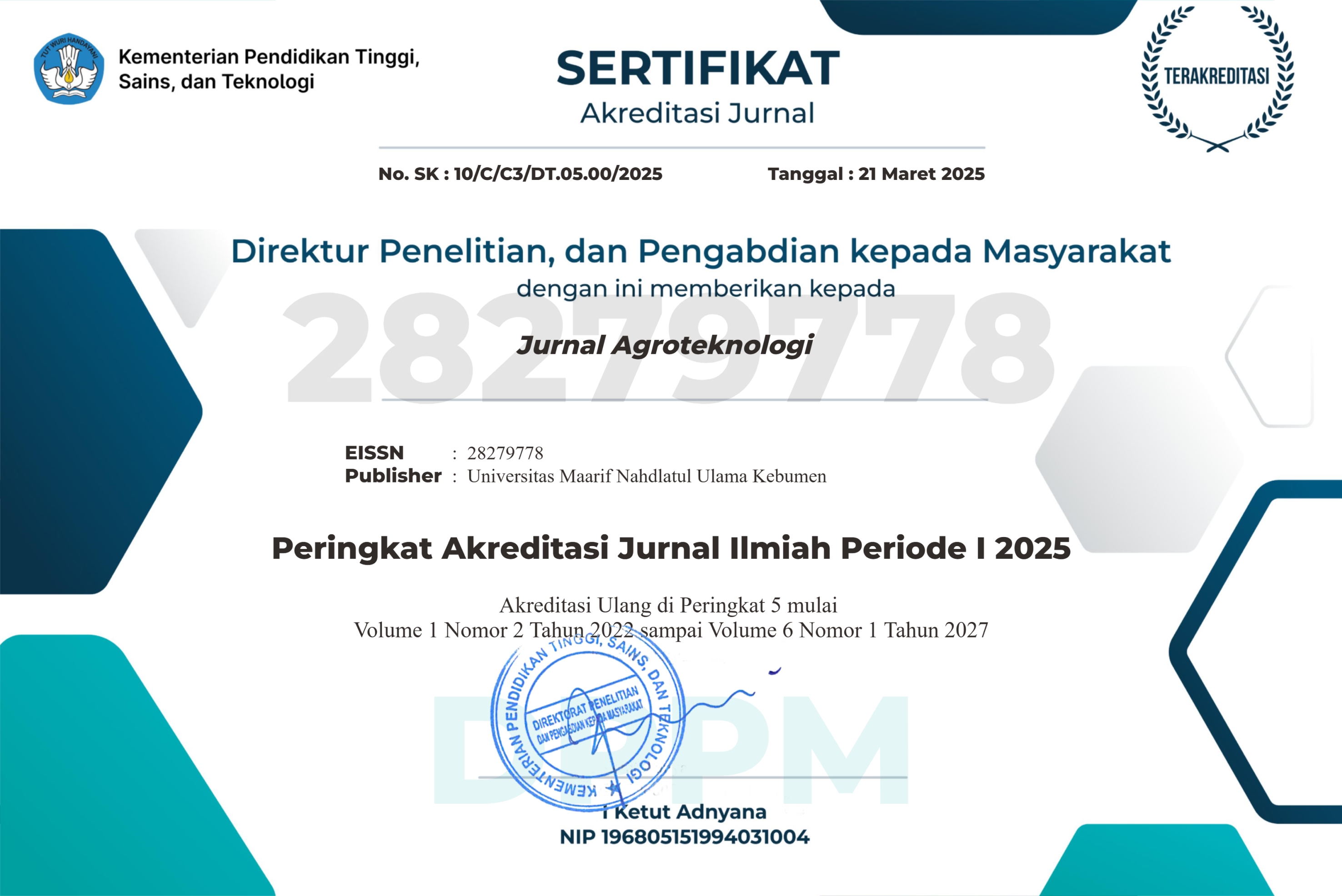

Jurnal Agroteknologi (Agronu) implement policies related to authorship/contribution (Contributorship Policy), roles and contributions to ensure that contributors who have made substantial intellectual contributions to a paper are recognized as authors, while ensuring that those who are recognized as authors understand their role in assuming responsibility and accountability for what is published.
Criteria as a Author
To be recognized as an author, one must meet the criteria according to the authorship principles of the ICMJE:
The party that meets the 4 criteria is the party listed as the author.
The individual who performs the work is responsible for determining who meets these criteria. Ideally, the determination is made from the planning stage, making necessary adjustments as the work progresses. We encourage collaboration and co-writing with peers at the research site. It is the collective responsibility of the authors, not the responsibility of the journal in which the work was submitted, to ensure that everyone listed as an author has met all four criteria. It is not the role of journal editors to determine who qualifies or does not qualify as an author, nor to mediate authorship-related conflicts. If no agreement is reached on who qualifies as an author, then the institution where the research was conducted, not the journal editor, should be asked to conduct an investigation. The criteria used to determine the order of author names can vary and should be decided collectively by the group of authors, not by the editors. If authors request the removal or addition of the author's name after the manuscript has been submitted or published, the journal editor must request an explanation and written consent regarding the change from all authors listed, including those authors to be removed or added.
Contributor Not Author
Contributors who do not meet the four authorship criteria above should not be listed as authors, but their contributions still need to be recognized (appreciated). Contributions in the form of administrative support, obtaining funding; general supervision of research groups or general administrative support; as well as writing assistance, technical editing, language editing, and proofreading. Therefore, they are not automatically written as authors. These contributions can be mentioned in the acknowledgments section, by explaining their role and obtaining permission from the party concerned.
Artificial Intelligence-Based Technology (AI)
When submitting a manuscript, the journal must ask the author to disclose whether they are using artificial intelligence-based technology (image creation tools) in the preparation of the work. Authors who use the technology must explain how the technology is used in the submitted manuscript, the AI Disclosure Statement just before the Bibliography section. For example, if AI is used to assist with writing, data collection, analysis, or image/illustration creation, e.g. *Chatbot* (such as ChatGPT). Since it cannot be held responsible for the accuracy, integrity, and originality of the work, that responsibility is an absolute requirement for authorship. Therefore, humans are solely responsible for any submitted material that involves the use of AI-based technology. Authors must carefully review and edit the results obtained because AI can produce conclusive-sounding outputs, when they may be inaccurate, incomplete, or biased. Authors are not allowed to list AI or AI-based technologies as authors or co-authors, and must not cite AI as authors. Authors must be able to guarantee that there is no plagiarism in their manuscripts, including in AI-generated text or images. Humans are obliged to ensure proper attribution for all cited material, including the inclusion of full citations.
Correspondence authors and author order
A corresponding author is an individual who bears primary responsibility for communicating with the journal during the manuscript submission, peer review, and publication process. Correspondence authors typically ensure that all administrative requirements of the journal although these tasks may be delegated to one or more co-authors. Correspondence authors must be willing to be contacted during the submission and peer review process to respond to editorial questions in a timely manner, and remain contactable after publication to respond to criticism of the work and work together to fulfill the journal's requests for additional data or information if questions arise about the article after publication. Although the author of the correspondence has primary responsibility for communicating with the journal,
Policy reference
International Committee of Medical Journal Editors (ICMJE)

| Indexing AGRONU |
|
|
|
Reference Tools |
|
|
|
Similary Checker Tools |
|
|
Rumah Jurnal
Universitas Ma'arif Nahdlatul Ulama Kebumen
Jatisari Street KM.05, Kebumen, Central Java, Indonesia.

This work is licensed under a Creative Commons Attribution-ShareAlike 4.0 International License.